Beginner Roller Skating Checklist: Safety, Skills, Plan
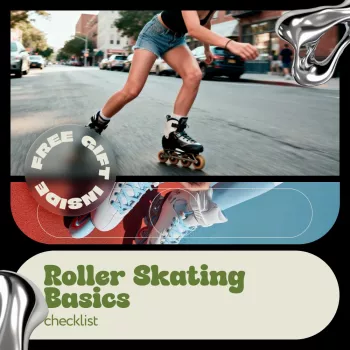
Beginner Roller Skating Basics Checklist: Skills to Learn, Safety to Set Up, and a Simple Practice Plan
Starting roller skating feels magical—and wobbly. A checklist turns that early-learning swirl into a clear path: what to wear, what to practice first, and which skills to repeat until they feel natural. Use this beginner-friendly roller skating basics guide to build confidence session by session, track progress, and celebrate every “I did it” moment.
What to set up before the first push-off
Before you chase bigger skills, we want you set up for fewer surprises and more “that felt better” reps.
- Choose a smooth, flat practice spot: an empty tennis court, a clean garage floor, or a quiet parking lot with good pavement.
- Wear protective gear every time: helmet, wrist guards, knee pads, and elbow pads. Beginners fall forward often—wrists and knees deserve backup.
- Dress for range of motion: snug shoes/boots that support ankles, long socks, and comfortable layers that won’t restrict bends and squats.
- Do a quick skate check: laces snug, trucks not overly loose, wheels spin freely, toe stops (or plugs) secure and even.
- Warm up for 3–5 minutes off-skates: ankle circles, gentle squats, hip openers, and a few calf raises to wake up balance muscles.
- Decide the goal for today (one skill only): keeping sessions focused makes progress obvious and less frustrating.
Fast pre-session safety check (30 seconds)
| Check | What “good” looks like | Fix if needed |
|---|---|---|
| Helmet fit | Level on head; straps snug; no rocking | Tighten straps; adjust sizing pads |
| Wrist guards | Snug with full palm coverage | Re-strap; choose correct size |
| Toe stops/plugs | Secure; same height on both skates | Tighten with tool; re-level |
| Laces/closures | Even tension; heel feels locked in | Re-lace; add heel lock technique |
| Wheels | Spin smoothly; no wobble | Remove debris; check axle nuts |
| Trucks | Stable; not overly wiggly | Tighten slightly; test again |
If you’d like a single page you can print and keep with your gear, our team made a focused, beginner-friendly download: Roller Skating Basics Checklist (printable).
The beginner skating skills checklist (learn in this order)
The fastest way to feel steady is to learn in an order that keeps you safe and lets you repeat good reps. We recommend moving on only when the current step feels calm at slow speed.
- Safe stance: soft knees, chest up, eyes forward, arms relaxed—this is your default posture between every skill.
- Falling safely: practice “down to knees” and “catch with pads,” avoiding straight-arm catches that strain wrists.
- Getting up: one knee down, skates under hips, hands on knee (not the floor), stand with control.
- Balance holds: stand still for 10–20 seconds, then try shifting weight left/right without rolling away.
- Marching steps: tiny steps forward, feet under hips, building comfort with rolling.
- Forward glide: push gently, then glide; aim for quiet wheels and steady hips.
- Stopping basics: toe stop (or plow stop) at slow speed before attempting anything faster.
- Turning: look where you want to go, then lead with shoulders and hips; practice wide turns first.
- Controlled speed: learn to slow down intentionally, not by panic-braking.
- Backward basics (optional early, essential later): bubbles/swashers backward and small backward steps near a wall.
For helmet fit fundamentals and general skating safety guidance, you can also review CDC helmet safety basics and the U.S. Consumer Product Safety Commission’s skate sports safety tips.
Practice plan: three short sessions per week that actually stick
Consistency makes your balance “click” faster than marathon sessions. Aim for 20–35 minutes, three times a week (or two, if that’s what your schedule allows).
Simple session template (repeat it every time)
- Warm-up (off-skates): 3–5 minutes
- Review one “easy win” skill: 5 minutes
- Focus skill: 10–15 minutes
- Cooldown: 5 minutes of gentle laps or relaxed glides
Four-week ramp-up
Weekly goal tracker (simple and realistic)
| Week | Primary goal | Repeat-until-true checkpoint |
|---|---|---|
| 1 | Comfort on skates | Can fall and get up without rushing or panic |
| 2 | Stop on purpose | Can stop from a gentle roll 8 out of 10 tries |
| 3 | Turn with control | Can do wide turns both directions without stepping off-balance |
| 4 | Build flow | Can skate 5 minutes continuously with relaxed posture |
Common beginner hang-ups (and quick fixes that help immediately)
Make progress visible: print, check off, repeat
A printable checklist makes beginner skills feel organized: it turns “I’m not improving” into “I checked off three things this week.” If you like having a one-page plan you can mark up, keep with your gear, and reuse month to month, we made our Roller Skating Basics Checklist (printable) to match the skill order and practice rhythm above.
More from our shop (in stock)
- Roller Skating Basics Checklist | Beginner Roller Skating Basics Guide | Printable Skating Skills Checklist ($5.99)
- Exaggerated Leaf Stud Earrings – Trendy Geometric Design ($3.82)
FAQ
How long does it take to learn the basics of roller skating?
Many beginners feel noticeably steadier after a few sessions, but truly “reliable basics” usually take a few weeks of consistent practice. If you skate 20–35 minutes, 2–3 times per week, you can typically build comfort with stance, controlled gliding, and a simple stop within that window.
What are the first three skills a beginner should learn?
Start with a safe stance, then practice falling safely and getting up, and add a basic stop at slow speed. These three unlock confidence because they help you stay stable, recover quickly, and control your speed before you try bigger movements.
Do beginners need protective gear even at slow speed?
Yes—slow speed is still enough to fall forward onto hands, wrists, and knees, which is extremely common early on. A helmet and wrist guards are especially important, and knee and elbow pads make it easier to practice without hesitating.















Leave a comment